Counterfeits have improved enormously, but they still cut corners in the same handful of places. This is the order we work through a shirt in, what each check is actually worth, and — just as importantly — what none of them can prove.
Find the article code on the internal neck or side-seam label. Search that exact code online. If it returns a different club, season or colourway, stop — that is the end of the conversation. If it returns your shirt, you have ruled out the laziest counterfeits and nothing more, so carry on to the crest backing, the fabric held against the light, and the price the seller is asking.
Roughly in order of how much weight each one carries. No single item on this list settles a shirt on its own — you are looking for a pattern, and especially for contradictions between two things that should agree.
Not a physical check, but still the strongest single predictor. A current-season shirt sells for roughly £60–£100 (about $75–$130) at retail, and player-issue versions considerably more. A brand-new, in-season shirt offered at £25 with free shipping from an unfamiliar seller is almost always counterfeit, no matter how convincing the tag photographs look. Genuine bargains do exist — end-of-season clearance, a collector thinning out a wardrobe, a mis-sized gift — but they come with a story that makes sense, and usually with the original receipt or the seller's own wear photos.
Every modern shirt carries a manufacturer article or style code. On adidas it looks like IT6493 — two letters and four digits. On Nike it looks like IB5339-133 — six characters, a dash, then a three-digit colour code. On Puma it is usually six digits and a two-digit colour, like 759203 01. The check that matters is not whether the code looks right, but whether the same code appears in every place it should: the internal neck or side-seam label and the cardboard hangtag, and whether searching that code online returns your exact club, season and colourway. A code that returns a different shirt entirely is the single most damning thing you can find.
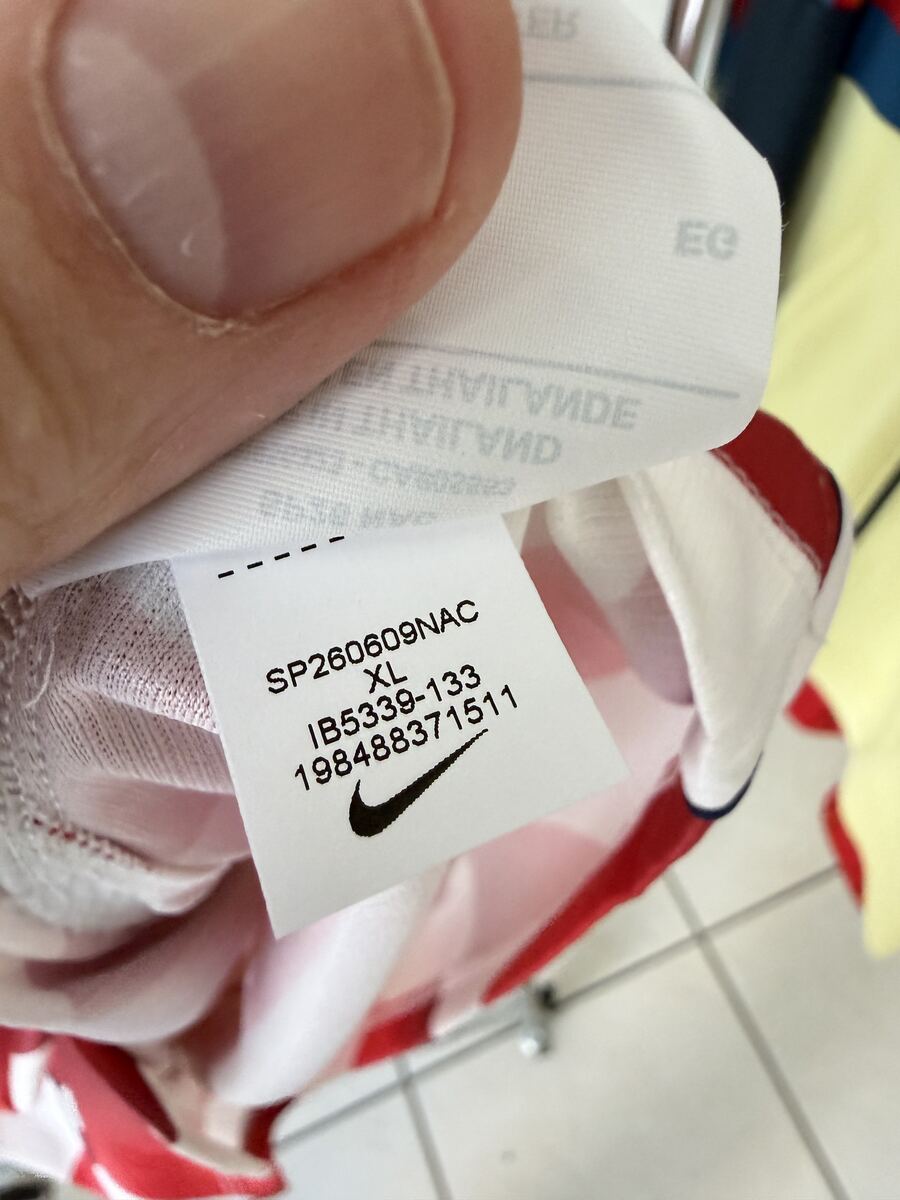
This is where counterfeits are caught most often, because it carries the most information in the least space. Look for even letter spacing, consistent stroke weight, and clean registration between the printed text and any logo behind it. Compare the size marking to the rest of the label — a genuine label prints the size, the article code and often a separate production code in the same typeface and the same ink density. Smudged edges, a slightly wrong shade of grey, or type that is very slightly too large for the label are all common tells. Feel it too: most genuine modern labels are heat-transferred and almost flush with the fabric, not a sewn-in tag that scratches.
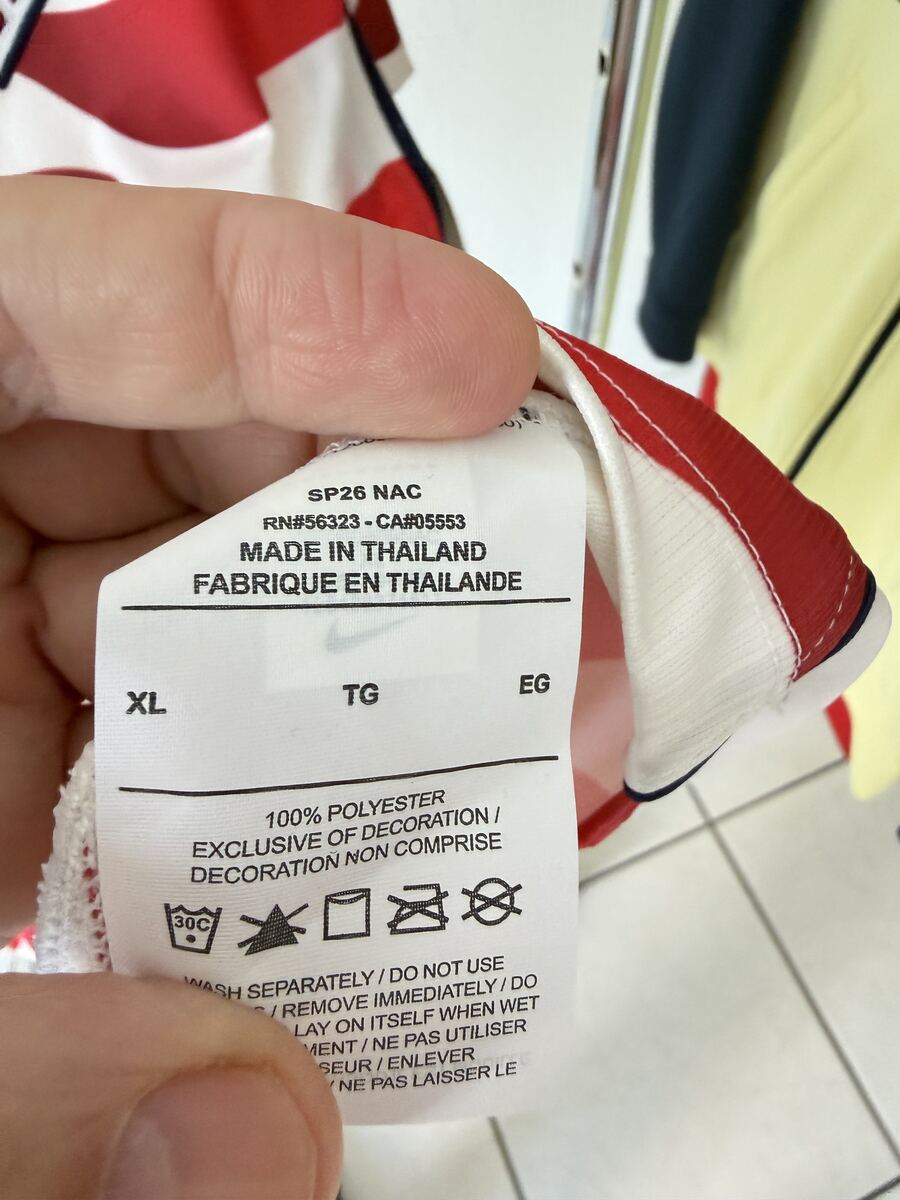
Usually stitched into the lower side seam. It should carry the fibre composition, the country of manufacture, a full set of wash-care symbols, and — on shirts sold into North America — an RN number and a CA number, which are registered identifiers for the company. Genuine shirts are commonly made in Thailand, Indonesia, Vietnam, Cambodia or Turkey, so 'Made in Thailand' is not itself suspicious. What is suspicious is a missing wash symbol set, a fibre composition that does not add up to 100%, spelling errors in any language on the label, or a country of manufacture that contradicts what the brand used for that season.
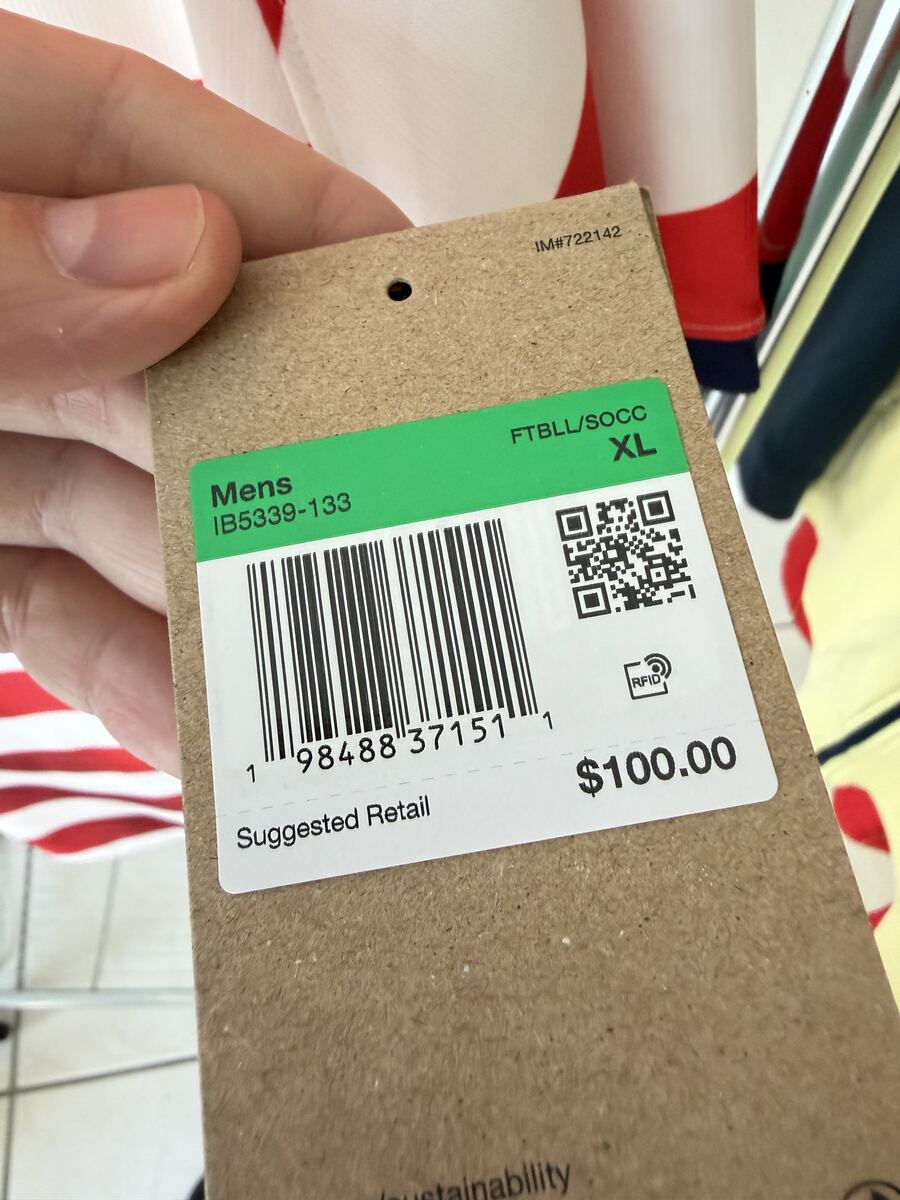
If the shirt still has its cardboard hangtag, you have been handed a gift: it carries the article code again, the product description, the colourway, the original price, and a barcode. Scan the barcode with any free phone app and see what comes back — on a genuine shirt it resolves to that exact product. Many recent shirts also carry a QR code and an RFID chip. A hangtag whose barcode scans to nothing, or to an unrelated item, is a serious problem. Bear in mind the reverse is not true: hangtags are detachable, so a genuine tag can be attached to a counterfeit shirt, which is why the tag alone never settles a case.
Turn the shirt inside out and look at the back of the crest. Genuine embroidery has dense, even backing stitches and a clean edge with no loose threads escaping the outline. From the front, check that colours are the club's actual shades rather than approximations, that gold or metallic threads have a genuine sheen rather than a flat yellow, and that fine internal details — a small animal, a ship, a set of letters — are legible rather than turned to mush. Many clubs use a heat-applied or silicone crest on replica shirts and embroidery only on the player version, so a printed crest is not automatically a fake; it needs to be the right treatment for that specific shirt.
The swoosh, the three stripes or the leaping cat is one of the most closely controlled elements on the shirt, and one of the hardest to reproduce exactly. Check proportion and angle against a retail photograph of the same shirt, not against memory. On the sponsor, look at the edges of the print: genuine sponsor logos are applied cleanly with sharp boundaries and sit flat against the fabric. Counterfeits often show a faint halo, a slightly rubbery raised edge, or a logo that has already begun to lift at a corner despite the shirt being described as new.
Modern shirts use engineered fabric with a specific weight and often a woven or embossed pattern that is part of the season's design. Hold the shirt up to a window. A genuine shirt is usually more opaque than people expect and has structure — it hangs rather than clings. Counterfeits are frequently lighter, shinier and more transparent, and any jacquard or embossed pattern is either shallow or slightly the wrong scale. If the design includes a subtle graphic woven into the fabric, that is one of the most expensive things to copy properly and one of the most reliable places to look.
Official namesets use a specific font licensed for that competition and season, applied by heat press or, for some shirts, stitched. Check the character shapes against an official image — counterfeit fonts are usually close but not exact, most visibly on numerals like 4, 6 and 7. Look at spacing between letters, and at the edges of each character under a strong light: genuine heat-applied lettering has a crisp boundary, while a counterfeit often shows a slight ripple or a visible glue outline. Cracking is not by itself evidence of a fake — genuine printing cracks with age and washing — but cracking on a shirt sold as new is a contradiction worth asking about.
Turn the shirt inside out and follow the side seams from hem to underarm. Genuine construction is even, tidy, and reinforced where the garment takes stress — the underarm join, the base of the collar, the hem corners. Collars are the giveaway: a genuine collar holds its shape, sits flat, and its internal taping is stitched down cleanly along its whole length. Puckering along a seam, a collar that curls, uneven hem width from one side to the other, or thread ends left long inside the garment all point the same way.
A large share of the shirts people believe are counterfeit are in fact genuine replicas being measured against player-version expectations. Know which one you are holding before you judge it.
Authentic · Match · Heat.RDY · Dri-FIT ADV
The specification worn on the pitch: lighter engineered fabric, a closer cut, bonded or laser-cut details, and usually a heat-applied crest. Retails far above the replica and is the version most often faked, because the price gap makes it worth faking.
Stadium · Fan version · AEROREADY · Dri-FIT
The version most fans own, sold in club shops worldwide. Roomier cut, heavier fabric, often an embroidered crest. It is a fully genuine, licensed product — 'replica' describes the tier, not a counterfeit. Plenty of shirts get wrongly called fake simply because someone expected player-version details.
Close-ups from a shirt we have handled and verified ourselves. Use them to compare fonts, placement, ink density and print quality against your own — not to match them exactly, since every brand and season differs.

Style code, size and UPC printed in sharp, even type directly above the swoosh. Compare spacing, ink density and the position of the code against yours.

RN and CA registration numbers, country of manufacture, fibre composition and a complete set of wash symbols — all crisp rather than smudged.

Barcode, scannable QR code and often an RFID icon, aligned cleanly on the card. Scan the barcode and see whether it resolves to this exact shirt.

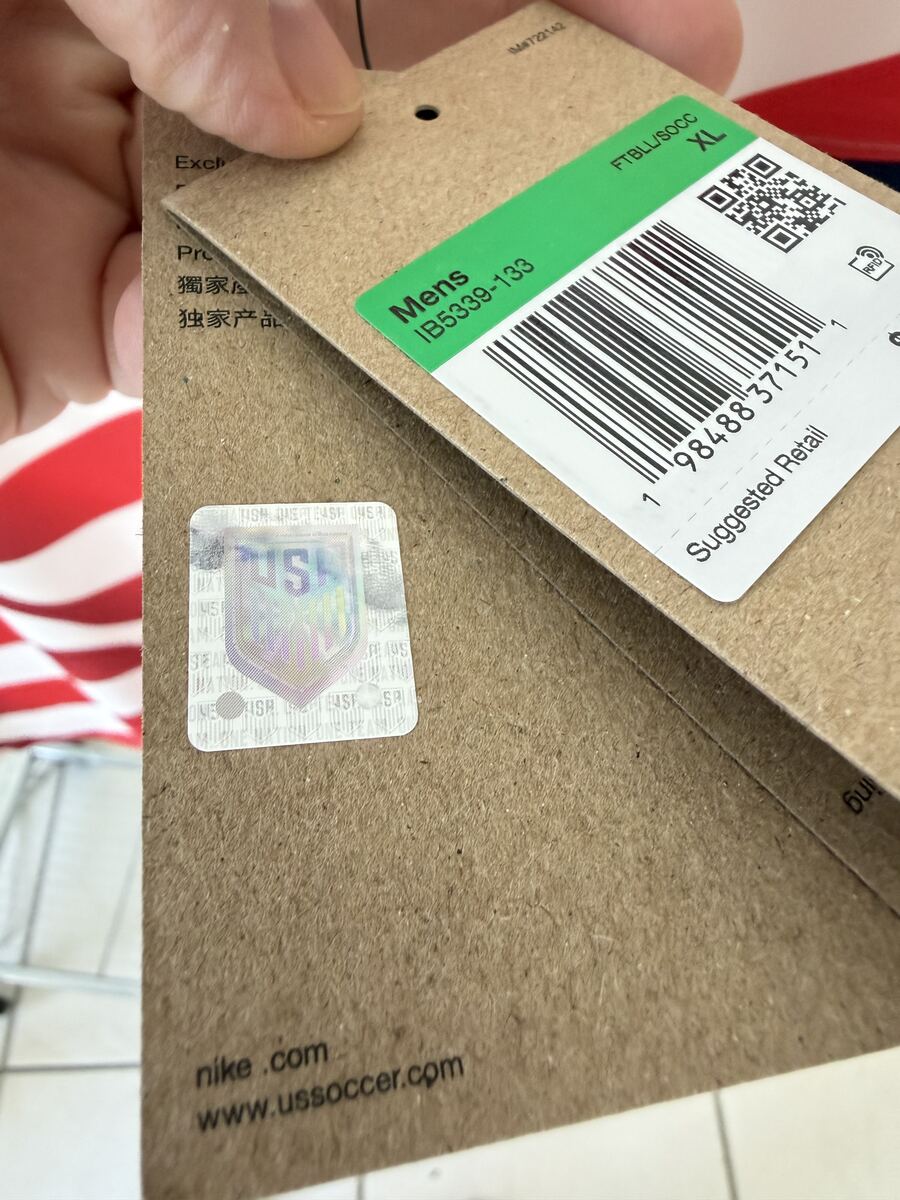
A real holographic sticker shifts colour and keeps a crisp logo when tilted. A flat, printed-looking 'hologram' that does not move is a red flag.
Every feature on this page — article code, care label, crest, sponsor, fabric structure, hangtag — is reproducible, and the better counterfeit operations reproduce all of them. That means a clean inspection is consistent with a genuine shirt and consistent with a very good fake. Photographs can find contradictions; they cannot establish origin.
What actually settles a difficult case is physical: scanning the hangtag barcode and QR code, reading the RFID chip where one is present, or comparing the shirt side by side against a confirmed-genuine example of the same article. When we cannot do those things, we say the case is unresolved rather than guessing — there is a worked example of exactly that in our case studies.
You can often tell that a shirt is fake, because counterfeits leave contradictions a camera picks up — a code that returns the wrong shirt, a font that is close but not right, embroidery that unravels at the edge. You cannot prove from photographs that a shirt is genuine, because every visible feature can be reproduced by a capable counterfeiter. Any service that tells you otherwise is overselling. That asymmetry is why our reports carry two separate numbers: how authentic the shirt appears, and how strong the evidence actually was.
No. It means the code is right, which is a good sign but a weak one — the article code is the first thing a counterfeiter copies, precisely because buyers know to check it. A wrong code is powerful evidence against a shirt. A right code is only mildly in its favour. We published a full case study on exactly this problem.
No, and this confusion causes a lot of unnecessary panic. Replica — sometimes branded Stadium or fan version — is the standard licensed retail tier that most supporters own. The player version is the on-pitch specification. Both are genuine. A shirt is only counterfeit if it was not made under licence at all.
Not necessarily. Genuine shirts are mass-produced garments and do have variation, loose threads and the occasional flaw. What matters is the pattern of evidence, not one detail in isolation. A single untidy seam on a shirt whose codes, labels, fabric and crest all check out is far less significant than a tidy shirt whose neck label code returns a different club.
It tells you about a seller's history across many transactions. It tells you nothing verifiable about the individual garment in front of you, which may have been bought in good faith from someone further up the chain. We deliberately give marketplace feedback no weight in our findings.
A marketplace deciding to remove a listing is a decision about a listing, not a documented examination of a garment. Platforms act at scale on listing text, imagery, pricing and seller history, and they reasonably err toward removal. It is a signal worth taking seriously and it is not the same thing as a finding about your shirt.
Send five clear photos — front, back, crest, and the two internal labels. Your first check is free, and you get the reasoning, not just a verdict.